
Views: 0 Author: Site Editor Publish Time: 2026-11-20 Origin: Site


Shifting from manual to automated overhead lifting goes far beyond a simple hardware replacement. It demands a fully synchronized ecosystem of software, advanced sensors, and precise mechanical controls. Industrial environments can no longer rely on isolated upgrades to stay competitive. Disconnected automation silos frequently cause major operational bottlenecks. For instance, a crane operating autonomously but failing to communicate with inventory software creates load sway delays and severe safety hazards. These blind spots destroy productivity and put personnel at risk.
True facility automation requires a fully integrated Unmanned Bridge Crane System where Warehouse Management Systems (WMS), Programmable Logic Controllers (PLCs), and redundant safety arrays operate in a continuous, low-latency loop. In this guide, you will learn how proper synchronization transforms overhead lifting operations. We will explore the critical architecture, software handshakes, and strict compliance layers required for success. You will also discover how to navigate complex tandem lifts and assess network infrastructure safely.
l Integration is the differentiator: An effective unmanned bridge crane system relies on real-time data handshakes between facility software (WMS/MES) and crane-level PLCs to dictate task prioritization and path planning.
l Synchronization prevents bottlenecks: Advanced wireless control protocols are required to manage multiple cranes in a single bay, enabling safe tandem operations and dynamic collision avoidance.
l Redundancy ensures compliance: Industrial automation demands multi-layered safety systems—combining LiDAR, the Gray Bus Positioning System, and mechanical limits—to meet stringent occupational safety standards.
l Brownfield risks are network-dependent: Retrofitting existing infrastructure requires strict assessment of track alignment and wireless network reliability (e.g., industrial 5G/Wi-Fi) to prevent latency-induced shutdowns.
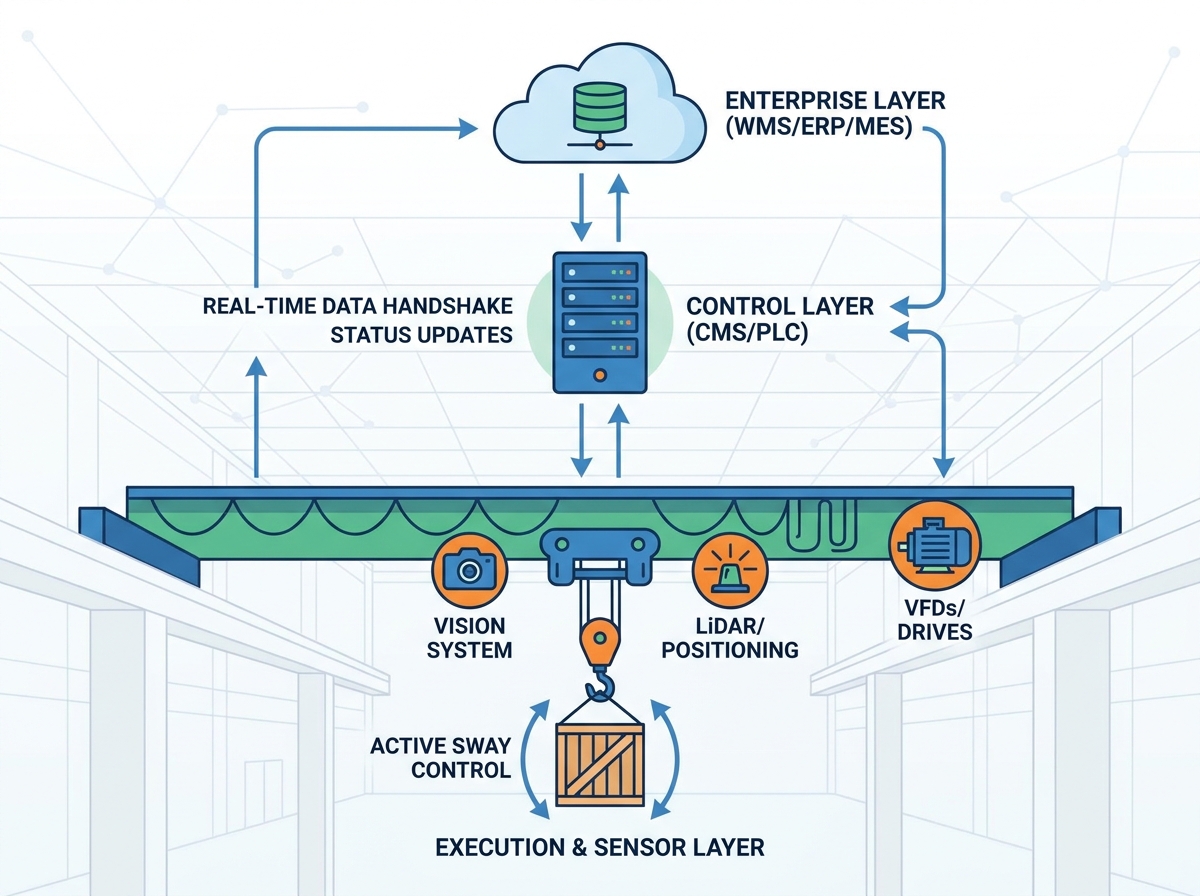
Automating a heavy-duty crane demands a structured, multi-layered technological approach. You cannot simply install sensors and expect seamless operation. We must break down automation into three distinct operational layers. Each level handles specific data types and executes unique responsibilities.
1. Enterprise Layer: This serves as the brain of your facility. Your Warehouse Management System (WMS), Enterprise Resource Planning (ERP), and Manufacturing Execution System (MES) operate here. They dictate exactly what needs moving and when it must happen.
2. Control Layer: This level processes high-level instructions. The central Crane Management System (CMS) and onboard PLCs reside here. They translate software commands into actionable path planning logic.
3. Execution & Sensor Layer: This tier performs the physical work. Variable Frequency Drives (VFDs), position encoders, machine vision cameras, and load cells act together. They execute precise movements while feeding telemetry back to the control layer.
When you evaluate vendors, always assess their open-architecture capabilities. Proprietary, closed-loop architectures often create severe vendor lock-in. They restrict your ability to integrate third-party sensors later. Open frameworks allow smoother facility expansions. They let you connect new AGVs or upgrade inventory software without replacing the entire crane interface.
The gap between facility software and mechanical hardware requires a perfect data handshake. The WMS identifies a specific SKU for retrieval. It sends this request to the control layer. The onboard PLC then calculates the precise X, Y, and Z spatial coordinates necessary to reach the target. It plots the most efficient route while avoiding known static obstacles.
Automated cranes must maintain absolute real-time inventory mapping. The moment a hoist places a load down, the PLC pings the WMS. It updates the inventory database in milliseconds. This continuous feedback loop maintains perfect inventory accuracy. It entirely eliminates the need for manual barcode scanning on the factory floor.
Table 1: Evaluation Dimensions for Software Integration
Evaluation Dimension | Features-to-Outcomes | Ideal Performance Standard |
Latency Limits | Prevents positioning overshoots and erratic stops. | Sub-millisecond response times. |
Integration Method | Determines complexity of software handshakes. | Direct API integrations. |
Middleware Usage | Adds unnecessary translation layers. | Avoid if possible; prefer native ERP support. |
Look for direct API integration capabilities. Systems using translation middleware often experience delayed data packets. Middleware adds unnecessary software complexity. Direct API links into standard ERPs like SAP or Oracle ensure highly reliable, low-latency communication.
Managing multiple automated cranes on the same runway presents a highly complex challenge. You must establish dynamic zoning protocols. These protocols prevent catastrophic collisions while maximizing runway usage. The control systems actively monitor the proximity of adjacent cranes. They dynamically adjust speeds to maintain safe buffer distances.
Tandem lifting synchronization demands even greater precision. Sometimes two hoists or two separate bridge cranes must lift a single oversized load. Imagine moving massive steel coils or fragile wind turbine blades. The system must synchronize speed and torque down to fractions of a second. Any deviation causes load binding or structural stress.
Chart: Wireless Control Protocol Summary
Protocol Type | Reliability Level | Tandem Lift Suitability |
Standard Wi-Fi | Low (Prone to interference) | Not Recommended |
Industrial 5G | Very High (Low latency) | Highly Recommended |
PROFINET (Wireless) | Exceptional (Real-time safety) | Mandatory for fail-safes |
Your choice of wireless control protocols dictates operational safety. Standard factory Wi-Fi frequently drops data packets amid heavy steel structures. In tandem operations, a single dropped packet triggers an immediate safety fault. This causes sudden downtime. You should prioritize industrial 5G or PROFINET over wireless. Evaluate the vendor's specific fail-safe behaviors. Ask how the system reacts during momentary network drops. Does it execute a controlled deceleration, or does it trigger a violent emergency stop?
An integrated Unmanned Bridge Crane System cannot rely on human intuition to catch a swinging load. The physics of automation require rigorous mathematical modeling. When a crane accelerates, the suspended load acts as a pendulum. The system must actively counteract this motion before it becomes dangerous.
The industry uses two primary approaches to anti-sway technology:
l Open-loop systems: These rely on pre-calculated algorithms. They use basic pendulum physics based on cable length. They cannot account for unexpected wind or off-center loads.
l Closed-loop systems (Recommended): These use real-time machine vision cameras. They pair visual data alongside dynamic load sensors. The system actively corrects sway by adjusting bridge and trolley speeds in real time.
Always opt for closed-loop sensing in environments handling varied load weights. A robust anti-sway system must guarantee load placement within strict millimeter tolerances. Evaluators should demand a +/- 5mm tolerance guarantee. This high precision is absolutely crucial for supporting fully automated truck loading. It is equally important for executing flawless handoffs to Automated Guided Vehicles (AGVs).
A frequent error involves tuning anti-sway algorithms using only empty hooks. You must calibrate the sensors across your entire load spectrum. Failing to account for environmental factors, like crosswinds in semi-open facilities, renders open-loop systems entirely ineffective.
Removing a human operator naturally invites skepticism. Workers worry about autonomous heavy machinery moving overhead. To build trust and ensure compliance, automated systems must utilize multi-tiered safety stacking. You cannot rely on a single sensor to prevent accidents.
A proper safety architecture includes three distinct tiers:
l Tier 1: Geofencing and Access Zones. This operates at the software level. The CMS maps restricted areas where the crane simply will not travel. It protects walkways and designated personnel zones.
l Tier 2: Active Environmental Scanning. The crane utilizes onboard LiDAR and 3D laser scanners. These sensors constantly monitor the factory floor for unexpected obstacles. If a forklift enters the drop zone, the system halts.
l Tier 3: Hardwired Mechanical Limits. These serve as the ultimate fail-safes. Hardwired limit switches physically cut power if software systems fail. They prevent the trolley from crashing into the runway end stops.
You must adhere strictly to authoritative industry standards. Compliance means meeting ISO standards for general crane safety. Furthermore, the electrical controls must align closely with IEC 61508 for functional safety. We operate under a transparent assumption here. Automation does not completely eliminate risk. Instead, it shifts the risk away from human operator error and places it onto system reliability. Because of this shift, redundant safety hardware remains non-negotiable.
Launching crane automation involves significant structural realities. A greenfield rollout is straightforward. Building a new facility allows you to design perfectly straight runways and robust network backbones from day one. Retrofitting a brownfield site requires intense preparation. You must perform comprehensive structural audits before buying software. Engineers must check existing rail alignment. They must measure runway deflection under maximum loads.
Experience reveals several common rollout risks:
l Dead Zones: Network infrastructure frequently fails to penetrate heavy steel environments. A dropped connection leaves the crane stranded mid-lift.
l Data Garbage: Poor WMS data creates chaos. If inventory records are wrong, the crane will attempt picks in empty slots. It might also try to place a load into an already occupied space, causing a collision.
l Sensor Blind Spots: Dust and industrial grime can affect laser scanner heads if not properly protected.
Use strict shortlisting logic when selecting integration partners. Prioritize vendors offering digital twin simulations. A digital twin lets you test WMS handshakes in a virtual environment prior to physical installation. Your immediate next step is clear. Commission a comprehensive facility network audit. Simultaneously, order a mechanical runway assessment. Complete both steps before issuing any formal Request for Proposal (RFP).
The operational success of an unmanned crane relies entirely on seamless integration. The facility enterprise software, onboard logic controllers, and real-time sensory data must function as one cohesive unit. Isolated technology upgrades simply do not work in modern industrial environments.
Investing heavily in physical hardware without rigorously evaluating the software integration architecture is a mistake. It will inevitably result in an expensive, underutilized asset. Automation only achieves its potential when data flows without interruption.
Before contacting integration vendors, document your facility's current baseline. Begin mapping out your existing WMS capabilities. Test your factory's wireless network infrastructure under heavy load. A clear understanding of your starting point guarantees a safer, smoother transition to fully automated overhead lifting.
A: Through integrated 3D laser scanners and LiDAR. These active sensors continuously scan the environment below. They dynamically alter the crane’s path or execute a controlled, immediate stop if any unmapped object or person enters the designated safety zone.
A: Yes, but it requires extensive retrofitting with new VFDs, continuous position encoders, and PLCs. A rigorous mechanical audit is absolutely necessary to ensure the existing structural runway can handle the highly precise tolerances required by automation.
A: You need highly reliable, low-latency wireless networks. Facilities typically deploy Industrial 5G or dedicated industrial Wi-Fi, such as leaky feeder cable systems. These ensure uninterrupted PROFINET or EtherNet/IP communication between multiple cranes during complex lifts.
A: It relies on a combination of closed-loop anti-sway technology, Gray Bus Positioning Systems located on the bridge and trolley, and machine vision cameras. For crane travel positioning, Wuhan Forward Technology’s Gray Bus Positioning System uses non-contact electromagnetic coupling with a Gray bus, antenna box, encoder, and decoder to provide absolute position data at a published 1 mm resolution, with project-configured PLC interfaces. Together, these technologies provide final millimeter-level target verification before lowering the load.


