
Views: 0 Author: Site Editor Publish Time: 2026-11-16 Origin: Site


Industrial automation is rapidly transforming material handling operations across heavy manufacturing sectors worldwide. Modern facilities no longer rely solely on human operators to navigate complex overhead lifting tasks. Transitioning to a fully automated Unmanned Bridge Crane System requires a fundamental shift in control architecture. You must replace human eyes and instincts with a robust, multi-layered sensor fusion network. Without precise and continuous data inputs, automated material handling becomes unreliable and potentially hazardous to your workforce.
This guide evaluates the critical sensor categories needed to achieve safe, repeatable, and highly efficient automated workflows. We will explore specific hardware requirements, system integration strategies, and practical vendor selection criteria. You will learn how to build an intelligent crane network while avoiding common implementation pitfalls. Ultimately, prioritizing the right sensor architecture ensures long-term operational success and reliable facility safety.
l Safety-First Redundancy: Automation relies on overlapping sensor technologies (Gray Bus Positioning System, absolute encoders, LiDAR, and vision) to prevent collision and ensure precise positioning.
l Positioning Precision: Absolute encoders and a Gray Bus Positioning System provide the positioning reference needed for millimeter-level accuracy in automated cycles.
l Environmental Resilience: Sensors must be selected based on environmental factors (dust, heat, light, or electromagnetic interference) specific to the facility.
l System Integration: The "intelligence" of the crane lies in how the PLC integrates sensor data to manage path planning and dynamic obstacle avoidance.
Before selecting hardware, you must establish clear baselines for operational success. Automation involves much more than simply moving a hoist from one point to another. It requires a comprehensive approach to process optimization and facility integration. You need to define exactly what your automated logistics workflow should achieve under peak operational demands.
Operational objectives usually center around cycle time reduction and consistent load stabilization. When an automated crane operates, it must follow optimized trajectories. Human operators often introduce variable speeds and rough stops. An automated system executes repeatable movements, reducing mechanical wear and shortening transfer times. Your success criteria should quantify these desired cycle time improvements.
Safety compliance forms the foundation of any "person-less" material handling strategy. Operating heavy machinery autonomously requires strict adherence to international safety standards. Functional safety frameworks, such as ISO 13849 and IEC 62061, dictate how control systems must respond to faults. You must design your sensor architecture to meet specific Performance Levels (PL) or Safety Integrity Levels (SIL). These ratings ensure the crane fails safely during an unexpected hardware malfunction.
Establishing clear success metrics prevents scope creep during implementation. Common success metrics for an automated crane project include:
l Positioning Accuracy: Achieving repeatable placement within ±2 to ±5 millimeters, depending on the payload.
l Load Sway Damping: Reducing pendulum motion to near-zero within two seconds of stopping.
l Fault-Detection Reaction Time: Processing safety sensor triggers and engaging mechanical brakes within milliseconds.
l Uptime Targets: Maintaining 99% availability through robust sensor telemetry and predictive diagnostics.
To navigate dynamic industrial environments, overhead cranes require diverse sensory inputs. We categorize these sensors into three primary functions: positioning, perception, and monitoring. Each category plays a distinct role in executing safe and accurate automated cycles.
Precision movement demands continuous location feedback. The control system must know the exact coordinates of the bridge, trolley, and hoist at all times.
Absolute encoders provide the backbone of high-resolution positional feedback. Unlike incremental encoders, absolute variants retain their exact position data even after a sudden power loss. This capability eliminates the need for manual homing routines during system restarts. Engineers typically mount these encoders directly to motor shafts or gearboxes. They translate rotational movement into highly precise digital coordinates.
However, mechanical slip between wheels and rails can compromise encoder accuracy over long travel distances. A Gray Bus Positioning System provides a non-contact absolute position reference for crane travel and can be integrated with encoder feedback. Wuhan Forward Technology specifies 1 mm resolution and 1 mm position detection accuracy. The system uses a Gray bus, antenna box, on-board or ground detection encoder, and decoder to convert Gray-code address signals into absolute position data. Because the antenna box and Gray bus operate without contact, the system avoids reader-to-track slippage and wear. The specified antenna-to-bus gap is 30–300 mm front and back and ±100 mm up and down. Listed communication interfaces include RS232C, RS458, Modbus, Modbus RTU, PROFIBUS, PROFINET, DeviceNet, Ethernet using TCP/IP through an RJ45 interface, and SSI. The resulting position data can be sent to the PLC for bridge-crane travel control and can also support stacker-reclaimer travel position and rotation-angle detection and ship loading and unloading machine position detection.
An automated crane shares its workspace with human workers, forklifts, and varying structural obstacles. The system must perceive its surroundings dynamically to avoid catastrophic impacts.
Industrial LiDAR scanners act as the primary safety net. You can program these safety scanners with custom warning and protection fields. When an object breaches a warning field, the crane automatically decelerates. If the object enters the protection field, the system triggers a hard emergency stop. LiDAR handles dynamic obstacle detection flawlessly across wide coverage areas.
3D vision systems and depth cameras complement LiDAR by providing volumetric data. While LiDAR detects presence, depth cameras analyze shape and dimension. The automated crane uses vision data to confirm load presence before hoisting. It can also dimension cargo on the fly and identify overhanging structural obstructions along the planned travel path.
Moving a load safely requires understanding its physical properties and dynamic behavior during transit.
Load cells provide real-time weight verification. You integrate these strain gauges into the hoisting mechanism to continuously monitor payload mass. Load cells prevent unsafe overloading scenarios. They also help the control system calculate the payload's center of gravity, which is crucial for balancing asymmetrical loads.
Inclinometers and micro-electromechanical (MEMS) accelerometers are essential for active load sway control. Whenever a crane accelerates or decelerates, the suspended load naturally begins to swing. Accelerometers measure this pendulum motion in real time. The control system uses this data to adjust trolley and bridge speeds, actively stabilizing the load.
Table 1: Critical Sensor Categories and Their Primary Functions
Sensor Category | Primary Hardware | Core Function | Industrial Application |
Positioning | Absolute Encoders | Rotational coordinate tracking | Trolley and hoist localization |
Positioning | Gray Bus Positioning System | Absolute position detection with 1 mm resolution | Bridge-crane travel positioning and automation integration |
Perception | Safety LiDAR | Dynamic field protection | Collision avoidance and E-Stops |
Perception | 3D Vision Cameras | Volumetric cargo profiling | Load confirmation and dimensioning |
Monitoring | Load Cells | Mass and strain measurement | Overload prevention |
Monitoring | Accelerometers | Inertial motion tracking | Active load sway damping |
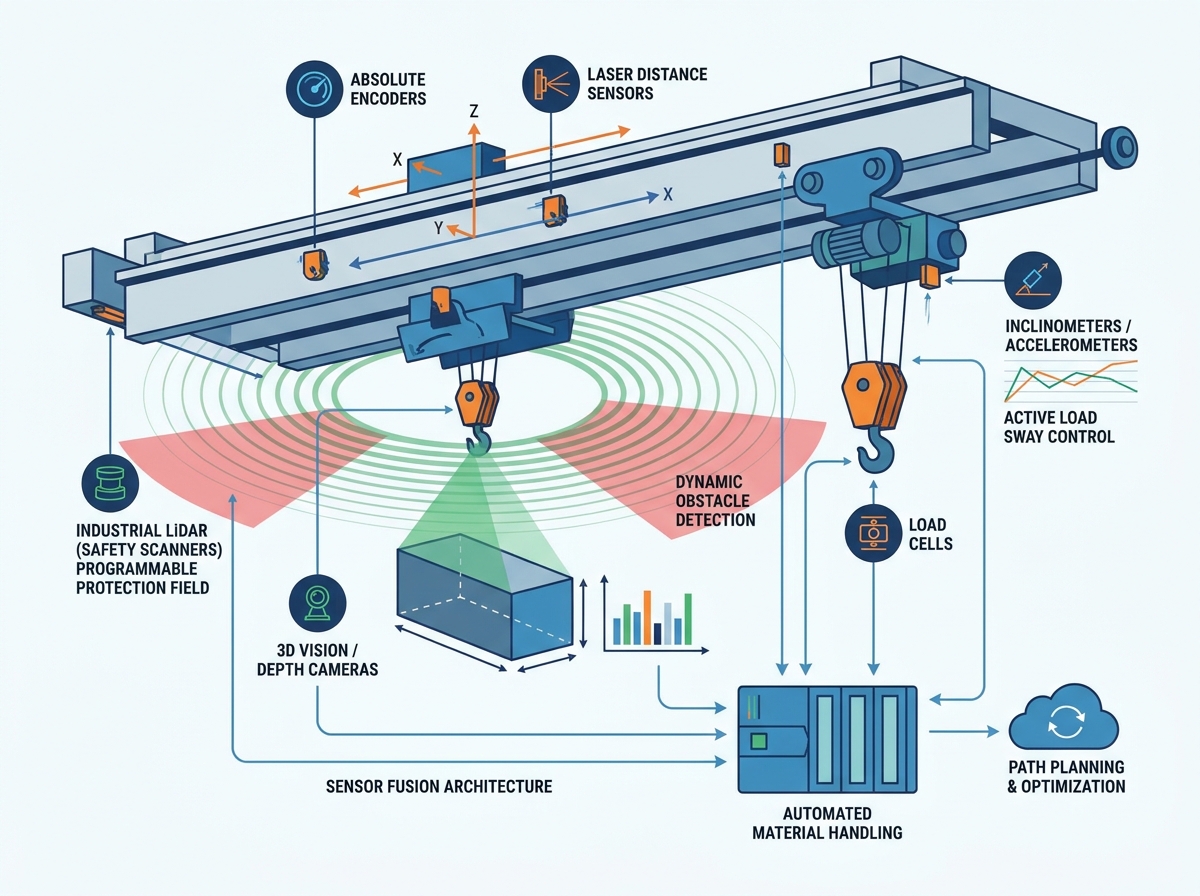
Deploying advanced sensors is only the first step. The true intelligence of an automated crane resides in its Programmable Logic Controller (PLC). The PLC must ingest, analyze, and act upon thousands of sensory data points every second. Flawless software integration bridges the gap between raw hardware signals and smooth autonomous motion.
A robust data fusion strategy is critical for preventing false-positive emergency stops. Industrial environments often generate conflicting sensor inputs. For example, a heavy vibration might briefly trigger an accelerometer, or ambient dust might scatter a LiDAR pulse. The PLC must reconcile these inputs using sophisticated filtering algorithms. If one sensor reports an anomaly while three others report normal operation, the system must evaluate the context before halting production.
The standard data fusion process typically follows these sequential steps:
1. Signal Acquisition: The PLC receives raw digital and analog signals from distributed field devices.
2. Integrity Validation: Software algorithms validate the signal integrity against expected operational tolerances to filter out electrical noise.
3. Cross-Referencing: The system compares primary encoder data with Gray bus position data to confirm exact physical positioning.
4. Execution: The PLC executes micro-adjustments through closed-loop feedback to the motor drives.
Sway control algorithms represent a highly complex aspect of integration. When transporting heavy materials, load swing poses a massive safety risk. The PLC uses real-time acceleration data and current hoisting height to mathematically calculate the pendulum's natural frequency. It then commands the variable frequency drives (VFDs) to apply counter-movements. These precisely timed motor bursts mathematically dampen the load swing without any human intervention.
None of this logic functions without strict connectivity requirements. Automated cranes require ultra-low-latency communication between distributed I/O modules and the main control architecture. High latency causes delayed braking and erratic sway control. Implementing industrial Ethernet protocols ensures deterministic data transfer, allowing sensors and controllers to synchronize within milliseconds.
Upgrading to a fully automated Unmanned Bridge Crane System introduces new operational challenges. Industrial facilities present harsh conditions. They can quickly degrade sensitive electronic equipment if you do not plan accordingly.
Environmental interference stands out as a primary implementation risk. Steel mills, foundries, and bulk material warehouses generate extreme heat and particulate matter. You must prioritize proper ingress protection (IP ratings) when selecting sensors. Specify IP67 or IP69K rated housings to protect delicate optics from fine dust and high-pressure washdowns. Furthermore, heavy industrial motors and VFDs emit intense electromagnetic interference (EMI). You mitigate EMI risks by utilizing shielded communication cables and isolating sensor power supplies from heavy load circuits.
Facilities also face the challenge of managing the maintenance of complexity. Automation fundamentally shifts maintenance requirements from mechanical repair to instrumentation and software support. Maintenance teams accustomed to greasing bearings must now troubleshoot fieldbus network errors. You mitigate this risk through comprehensive workforce retraining. Invest in diagnostic software interfaces so your technicians can easily identify failing sensors before they cause a system-wide halt.
The risk of false stops plagues many poorly integrated crane systems. Highly sensitive safety sensors often react to non-threatening environmental edge cases. Thick steam, flying sparks, or even dense exhaust smoke can trick a safety scanner into initiating an emergency stop. You handle these edge cases by implementing zone-based sensor muting. During specific phases of the operation-such as hovering directly over a molten ladle-the PLC temporarily ignores specific optical sensors and relies solely on mechanical position limits. This strategy maintains functional safety while preventing nuisance trips.
Choosing the right hardware partners heavily influences the long-term viability of your crane automation project. You must evaluate sensor vendors strictly beyond their upfront hardware costs. A cheap sensor often leads to expensive integration headaches and extended facility downtime.
First, verify strict network interoperability. Does the sensor natively support the fieldbus protocols utilized by your existing PLC architecture? Look for devices offering native integration with Profinet, EtherNet/IP, or EtherCAT. Native protocol support eliminates the need for clunky third-party gateways. Vendors should readily supply integration files (such as GSDML or EDS files) and Add-On Instructions (AOIs) to streamline PLC programming.
Next, assess the depth of support and documentation. High-performance automation requires nuanced configuration. You need vendors who provide detailed integration manuals, wiring schematics, and clear commissioning guidelines. Prioritize partners who offer accessible regional technical support. When a critical safety scanner faults at 2:00 AM, waiting for an overseas response is unacceptable.
Finally, demand rigorous compliance verification. Industrial insurance providers and local safety boards require documented proof of functional safety. Confirm the specific Safety Integrity Level (SIL) or Performance Level (PL) ratings of every collision avoidance and load monitoring device. A vendor must provide certified documentation demonstrating their hardware meets international standards for automated machinery environments.
An autonomous crane network relies entirely on the quality, speed, and accuracy of its sensory inputs. By combining high-precision absolute encoders with a Gray Bus Positioning System for non-contact absolute travel detection, redundant safety LiDAR, and robust load-monitoring hardware, facilities can build a more reliable automation architecture. Successful deployment transforms chaotic, variable material handling into a highly predictable and safe logistical workflow.
To ensure a smooth transition to autonomous operations, follow these actionable next steps:
l Audit your current facility environment to identify potential sensor blind spots, such as extreme dust zones or high EMI areas.
l Prioritize functional safety ratings (SIL/PL) when building your initial hardware specifications to satisfy compliance requirements early.
l Partner with sensor vendors offering native fieldbus integration to simplify your overall PLC architecture.
l Establish a predictive maintenance schedule utilizing real-time sensor telemetry to identify degradation before it causes operational downtime.
A: While all components are vital for safe operation, absolute encoders and the Gray Bus Positioning System form the core of precise crane positioning. Absolute encoders provide rotational coordinate feedback, while the Gray bus provides non-contact absolute travel position data with a published 1 mm resolution and no cumulative address error. Safety LiDAR remains the primary defense against catastrophic collisions, making it equally essential for personnel protection.
A: Yes, retrofitting is entirely possible. However, it requires a comprehensive overhaul of the existing control system. You must add modern sensing hardware, upgrade the PLC architecture, and replace outdated motor drives. It is never just a simple software upgrade.
A: Maintenance shifts significantly toward diagnostic monitoring. You must ensure your selected sensors provide usable status data and that the Gray bus, antenna box, encoder, and decoder remain within the specified installation clearances. The non-contact Gray bus design avoids reader-to-track wear and slippage, while the central control system can alert technicians to inspect mounting, wiring, signal quality, and other sensor conditions before downtime occurs.
A: Specialized industrial-grade sensors must be selected against the actual site conditions. Wuhan Forward Technology's Gray Bus Positioning System uses non-contact detection and sealed, non-metallic outdoor components designed for industrial environments involving dust, acid, alkali, and high temperature. The supplier's published application range includes bridge cranes, stacker-reclaimers, ports, metallurgy, mining, railways, and power plants. Confirm the equipment configuration, mounting clearances, communication interface, and environmental requirements during engineering and commissioning.


