
System Overview
The slab yard is the vital link between steelmaking and hot rolling. How well it is managed directly impacts production coordination and energy efficiency. Traditional slab yards rely heavily on manual record-keeping, verbal dispatching, and operator experience. This often results in delayed information, disorganized stacking, frequent rehandling, and low hot charging rates.
Wuhan Forward Technology's Slab Yard Intelligent Management System integrates and automates the management of both steelmaking and hot rolling slab yards. It provides intelligent control over the entire slab journey—from when a slab leaves the continuous caster to when it is charged into the reheating furnace. The system combines multiple technologies: precise crane positioning, smart stacking recommendations, automated roller table transport, real-time material tracking, crane-ground coordination, and video surveillance. It connects seamlessly with higher-level systems such as MES and L2. From a central control room, operators can monitor the entire yard in real time while the system automatically assigns crane tasks, controls roller tables, and suggests optimal stacking locations. This significantly improves efficiency and management precision, ensuring smooth coordination between casting and rolling.
Core Technologies
1. High-Precision 3D Positioning
Using Gray Code positioning technology, the system tracks the crane's bridge and trolley positions in real time with millimeter accuracy. This provides reliable location data for guiding crane operations, verifying positions, and coordinating multiple cranes working in the same area.
2. Intelligent Stacking Recommendations
An advanced algorithm analyzes multiple factors—including steel grade, slab dimensions, rolling schedules, stacking rules, cooling requirements, and retrieval order—to recommend the best storage location for each incoming slab. This minimizes future rehandling and improves the hot charging rate.
3. Automated Roller Table Transport with Safety Interlock
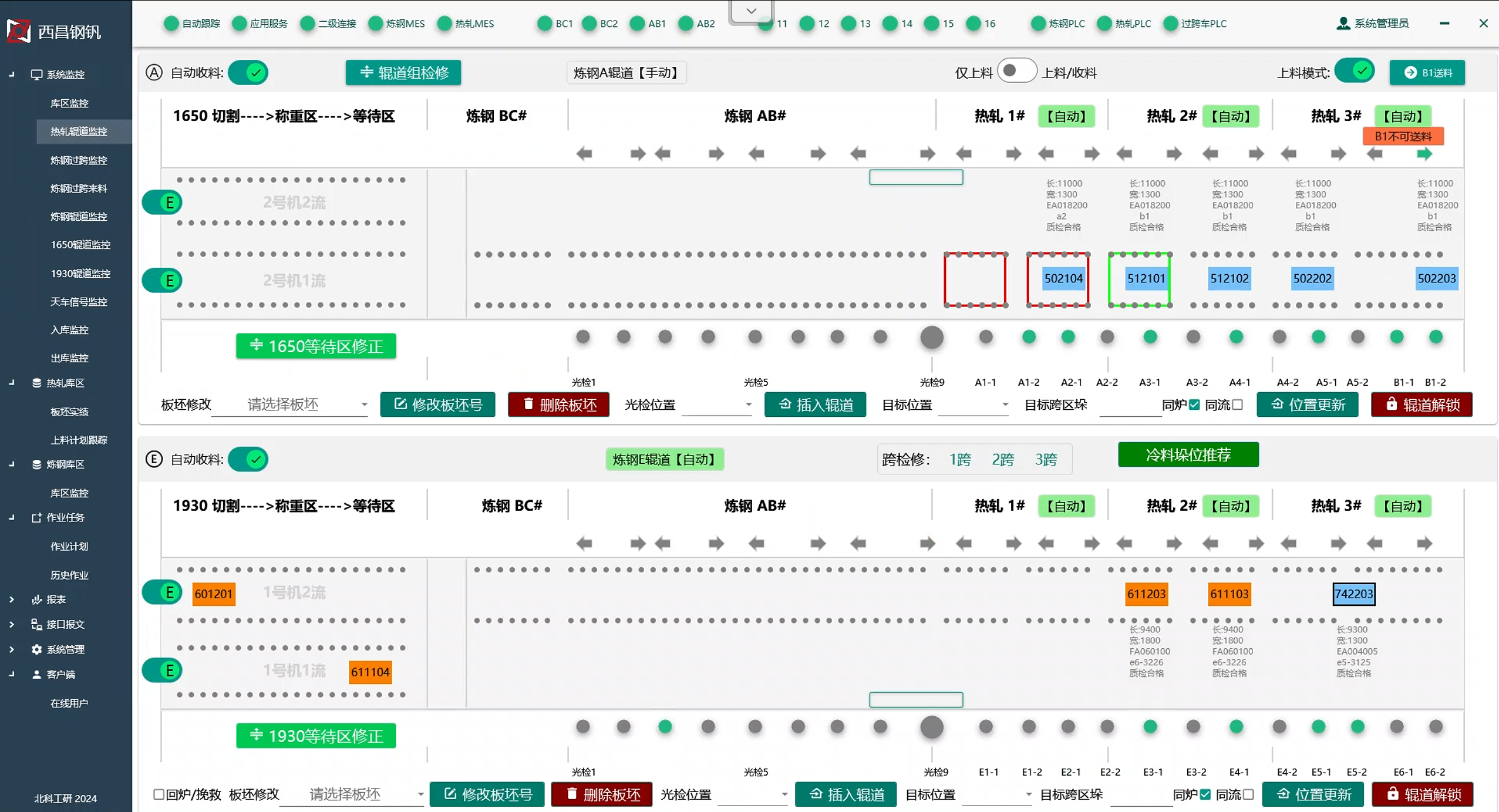
The roller table control system is upgraded with photoelectric sensors for automatic slab positioning and transport. Following instructions for storage or retrieval, the system moves slabs to the correct roller table group. A safety interlock ensures that when a crane picks up or places a slab, the corresponding roller table is automatically locked, preventing accidental movement.
4. Full Material Tracking
Each slab is assigned an electronic tracking record from the moment it is cut. Through roller table monitoring, crane operation confirmations, and handheld terminal inputs, the system tracks every slab's location, status, and quality in real time. This ensures that digital records always match physical inventory and allows for one-click traceability.
5. Crane-Ground Coordination
Inside the crane cabin, a display terminal shows operators their assigned tasks, the crane's current position, roller table status, and navigation guidance to the target stack. Operators follow the on-screen instructions, and the system automatically verifies that they are at the correct location. When a task is completed, inventory data updates instantly, keeping information and material flow synchronized.
6. Slab Number Recognition and Handheld Terminals
The existing slab number recognition system is upgraded for higher accuracy. Handheld terminals are provided for tasks such as inventory counting, information verification, and flagging abnormal slabs, ensuring data integrity in areas where full automation is not yet practical.
What problems does the system solve?
• Eliminates information silos, connects upstream and downstream operations
Real-time information sharing between steelmaking and hot rolling eliminates the delays and errors associated with phone calls and manual note-taking, enabling better coordination.
• Reduces manual workload, lowers labor intensity
Automated stacking recommendations replace guesswork. On-screen crane guidance replaces walkie-talkie instructions. Automated roller table transport replaces manual control. Yard managers are freed from constant, repetitive dispatching tasks.
• Increases hot charging rate, reduces rehandling
By intelligently placing slabs with future retrieval in mind, slabs designated for hot charging are stored in easily accessible locations. This minimizes unnecessary rehandling, significantly improving the hot charging rate and reducing overall rehandling.
• Prevents loading errors, ensures stable production
The system automatically verifies slab information and target positions during crane operation, issuing alerts if discrepancies are detected. Roller table interlocking prevents accidental movements, greatly reducing downtime caused by feeding errors.
• Provides complete inventory visibility, enables refined management
A 3D yard map displays real-time inventory distribution. Data can be analyzed by steel grade, dimensions, time period, and other criteria. Automatic shift and daily reports provide accurate information for better production decisions.
• Open and scalable, ready for future upgrades
The system is designed with future expansion in mind, reserving interfaces for unmanned cranes, intelligent scheduling, electric furnaces, and other advanced features—protecting your investment over the long term.
Core Application Industries
This system is specifically designed for slab yards in the steel and metallurgy industry, including:
• Steelmaking continuous casting slab yards – Receiving slabs from the caster, storing them according to process requirements, conditioning, and feeding.
• Hot rolling slab yards – Preparing and feeding slabs based on rolling schedules, managing purchased slabs, and handling returns.
• Multi-bay, multi-crane environments – Ideal for large yards with complex logistics and multiple cranes operating simultaneously.
The system can be deployed in new smart factories or retrofitted into existing facilities. It supports integration with steelmaking MES, hot rolling MES, L2 process control systems, and more.


