
Views: 0 Author: Site Editor Publish Time: 2026-11-11 Origin: Site


Modernizing legacy infrastructure to support autonomous workflows is a massive strategic pivot. Heavy industries face constant pressure to maximize throughput while minimizing human exposure to hazardous zones. However, moving from manual, operator-dependent routines to pure autonomous precision carries significant technical risk. Facility managers must realistically assess if aging structural and electrical assets can handle advanced intelligence demands. Slapping new software onto old steel rarely yields flawless results. In this guide, we break down the true challenges of hardware retrofitting. You will discover how to evaluate mechanical limits and bridge the sensory gap. Ultimately, you will learn how to safely implement an Unmanned Bridge Crane System in your existing facility.
Structural Integrity vs. Intelligence: Retrofitting is not just software installation; it requires validating that existing steel and mechanical drive systems can handle the increased wear associated with high-frequency, autonomous movement.
Precision and Sensing Gap: Bridging the gap between legacy analog control and the high-fidelity sensor arrays (LiDAR, machine vision, encoders) needed for true "unmanned" status.
The Cost-Benefit Threshold: Distinguishing between superficial "upgrades" and the full-system integration required to safely remove the human operator from the floor.
Operational Risk: Identifying potential failure points in existing hardware that are often exacerbated by the increased speed and repetitive accuracy of autonomous systems.
Retrofitting an old system begins with a hard look at physical realities. Old girders and gearboxes must seamlessly merge with cutting-edge software. We must determine if these aging skeletons can support robotic brains.
Determining if legacy hoists and bridges can handle precise, high-cycle acceleration and deceleration is critical. Automated software demands aggressive, consistent movement profiles. Human operators naturally smooth out jerks and stops using their intuition. Software, however, commands immediate torque to meet strict cycle times. We must carefully audit wheel assemblies, gear teeth, and bridge girders. They often suffer accelerated fatigue under robotic consistency. Identifying micro-fractures early prevents catastrophic mechanical failures down the line.
Evaluating existing panels reveals severe space and power limitations. Modern Programmable Logic Controllers (PLCs), Variable Frequency Drives (VFDs), and localized processing units need ample room. They also demand clean, uninterrupted power. Legacy relay panels simply cannot drive an Unmanned Bridge Crane System. You must account for extensive rewiring costs and plan for entirely new enclosure footprints. Skipping electrical upgrades usually results in blown fuses and erratic sensor behavior.
Identifying how legacy conditions impact delicate sensor arrays is vital for long-term success. Extreme temperatures, airborne dust, and structural vibration wreak havoc on navigation lasers. Machine vision cameras easily blind in harsh warehouse lighting or smoke. You must design robust protective housings to keep collision avoidance systems online. Failing to isolate sensors from environmental stress guarantees frequent system stalls and inaccurate load positioning.
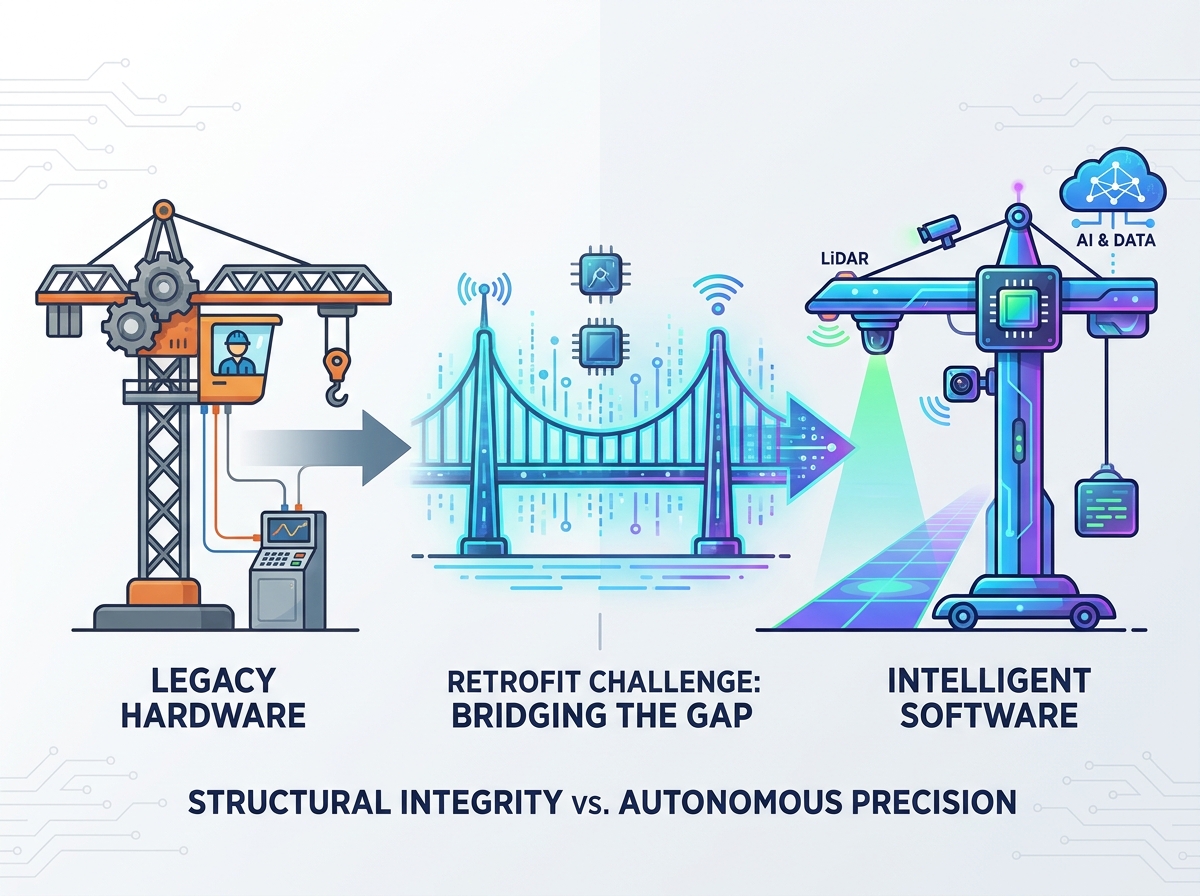
Integrating new tech into old infrastructure uncovers major operational bottlenecks. Real-time data processing requires a flawless digital backbone. If the network falters, the entire automated workflow crumbles instantly.
The challenge of integrating real-time data from disparate legacy sensors is immense. Adding new IoT-enabled monitoring devices compounds the integration issue. Command lag is entirely unacceptable during heavy load transport. Processing LiDAR, optical cameras, and absolute encoders requires millisecond precision. Any delay between sensing an obstacle and applying the brakes creates severe safety hazards. Engineers must deploy high-speed edge computing to eliminate sensor fusion latency.
Moving from physical pendant controls to robust industrial networks is mandatory. Old radio controls cannot handle 24/7 autonomous heartbeat signals. We must deploy low-latency, high-bandwidth wireless architectures. Private 5G or industrial Wi-Fi networks prevent unexpected signal drops. Dropped packets instantly halt an autonomous crane, killing productivity. Building a redundant network guarantees continuous communication between the crane and the warehouse management system.
Reconciling old-school limit switches and mechanical stops is incredibly tricky. Modern setups use software-based safety zones and dynamic obstacle detection. We cannot simply discard hard physical limits. Instead, we must layer digital geofencing directly over mechanical fallbacks. If the software crashes, the hard switches must safely arrest crane momentum. True redundancy means trusting the software but relying on physics for ultimate safety.
Upgrading old equipment is not always the smartest financial move. Sometimes, starting fresh makes more operational sense. We must weigh the realistic integration challenges of both paths carefully.
A solid framework helps calculate the realistic ROI of a retrofit. We must compare the remaining service life of the structural steel against new alternatives. If the main bridge girders have only five years left, retrofitting wastes capital. A full "clean-slate" automated system often provides decades of reliable uptime. You must rigorously evaluate metal fatigue before investing heavily in expensive automation hardware.
Strategic Hardware Approach Comparison
Evaluation Metric | Retrofitting Legacy Cranes | Clean-Slate Replacement |
|---|---|---|
Implementation Time | Usually faster, avoiding heavy structural teardowns. | Requires extended downtime for demolition and rebuilding. |
Mechanical Risks | High. Hidden metal fatigue can cause early failures. | Low. Brand new structural components guarantee reliability. |
System Integration | Complex. Requires reverse-engineering old systems. | Seamless. Built ground-up for modern digital environments. |
Safety Certification | Difficult. Custom engineering requires rigorous local audits. | Easier. Turnkey systems arrive with OEM pre-certification. |
Accounting for the "integration premium" catches many managers off guard. This includes the added labor and testing required to map legacy mechanical quirks into the new software control model. Engineers spend countless hours tuning drive parameters to mask gearbox backlash. These temporary software workarounds drain budgets quickly. You must budget generously for unexpected troubleshooting during the commissioning phase.
Navigating the legal and insurance hurdles is notoriously difficult. Certifying a "home-grown" retrofitted automated system involves strict regulatory scrutiny. Auditors demand extensive proof of functional safety under all conditions. Conversely, a turnkey OEM solution usually arrives pre-certified. Pre-certified systems streamline insurance approvals and simplify ongoing regulatory compliance for facility managers.
Deployment requires careful staging and patience. Rushing into full autonomy causes catastrophic operational bottlenecks. We must aggressively protect daily throughput during the entire transition phase.
Implementing "semi-autonomous" or "operator-assist" modes minimizes initial risk. We use these modes to test system responsiveness thoroughly. Operators supervise the AI, correcting jerky movements or sensor blind spots. This phased approach validates software reliability before committing to full unmanned status. It allows fine-tuning without halting critical daily warehouse output.
The shift from crane operators to system monitors introduces a steep learning curve. This training gap often creates the greatest bottleneck in post-retrofit performance. Workers must learn to interpret HMI dashboards and troubleshoot sensor alerts quickly.
Follow these best practices to upskill your team effectively:
Initiate digital literacy training months before the actual hardware installation.
Create digital simulation environments for low-stress interface familiarization.
Pair veteran crane operators with IT support staff for mutual cross-training.
Develop clear, visual troubleshooting guides for rapidly deciphering error codes.
Designing manual override workflows is absolutely essential for risk management. When the automated system encounters a "logic error" or sensor fault, operations cannot stall indefinitely. Workers need a physical remote or pendant to take immediate manual control. Clear recovery protocols ensure production resumes within minutes of a software fault. You should drill these recovery procedures regularly with floor staff.
Not every warehouse is a good candidate for robotic control. You must honestly assess your operational maturity. We categorize facility readiness into two distinct tiers.
These facilities handle standardized cargo and demand continuous high throughput. They possess a modern, post-2015 structural and electrical backbone. Their floors are highly organized, well-lit, and flawlessly digitally mapped. These environments represent ideal candidates for immediate, full-scale autonomous deployment. They will see the fastest operational returns on their investment.
These facilities require extensive, costly hardware modifications before software integration. Their layouts involve mixed cargo dimensions and unpredictable floor traffic. Here, "unmanned" refers more to specific semi-autonomous tasks rather than full warehouse integration. They benefit most from targeted, incremental upgrades that slowly modernize their workflows.
We summarize criteria across structural, budgetary, and operational dimensions. This checklist determines if a full retrofit or a targeted upgrade path is the most reliable path to operational ROI.
Inspect main girders and end trucks meticulously for hidden micro-fractures.
Verify available electrical panel space and ensure robust climate control.
Confirm your floor inventory is strictly tracked by a modern Warehouse Management System.
Secure a flexible budget for both software integration and unforeseen mechanical repairs.
Ensure your local maintenance teams can actively support basic IT and sensor troubleshooting.
Transitioning to autonomous lifting is a complex, iterative technical project. It is never a simple hardware purchase. You must prioritize a rigorous audit of existing mechanical limits before layering on complex autonomous software. Treat the entire retrofit as a holistic digital transformation. This mindset prevents you from treating the project like mere equipment maintenance. Build robust failure recovery plans, ensuring swift manual overrides protect daily throughput. By following these structured steps, you mitigate integration risks effectively. Your thoughtful approach ensures the investment delivers immediate, safe, and scalable operational gains.
A: The biggest risk is the misalignment between the precision of the new software and the actual physical tolerances of the legacy crane components. Old gearboxes have natural play. Forcing rigid digital commands onto worn mechanics often leads to accelerated metal fatigue or "false positive" sensor stops, severely stalling production.
A: Almost always. To ensure safety and reliability, existing aging control systems usually need replacement. You must install modern PLCs, digital encoders, and industrial network modules. Upgrading the panels ensures enough processing power and speed to support the required real-time sensor feedback loops.
A: Retrofitting is often more labor-intensive than a new install because it involves "reverse-engineering" existing infrastructure. Engineers must custom-fit sensors to old steel. However, a retrofit smartly avoids the massive lead times associated with complete structural procurement and heavy facility construction.
A: Yes, but it requires highly robust dynamic obstacle detection. Facilities must implement sophisticated safety zoning to prevent incidents between the autonomous crane and human floor personnel. Immediate mechanical fallbacks must also remain active alongside the software layers to ensure total workplace safety.


