
Views: 0 Author: Site Editor Publish Time: 2026-08-08 Origin: Site


Uncontrolled load sway serves as a major disruptor in overhead material handling. The notorious pendulum effect drives cycle time delays, accelerates structural fatigue, and causes severe safety incidents. Experienced crane operators often attempt to manually mitigate this sway through careful maneuvers. Relying purely on human skill scales poorly in high-throughput or highly precise industrial environments. Inconsistent operation inevitably leads to production bottlenecks and hazardous conditions. Facilities need a reliable solution to ensure safe, continuous operations. Transitioning to an automated Anti-sway Control System shifts load stability from a variable human skill to a predictable, system-governed baseline. You will learn exactly how these systems function and the core benefits they deliver. We will also explore how to evaluate the right technology for your specific operations. Finally, we will cover critical implementation realities to ensure a highly successful rollout.
Anti-sway control systems rely on either predictive mathematical models (open-loop) or real-time sensor feedback (closed-loop) to counteract pendulum motion.
Core business benefits include quantifiable cycle time reductions, lower barrier to entry for operator proficiency, and reduced mechanical stress on crane components.
Evaluating a system requires assessing VFD/PLC compatibility, environmental conditions (dust, visibility), and integration complexity.
Successful implementation demands proper initial calibration and addressing operator change management, rather than treating the system as pure "plug-and-play."
Uncontrolled sway severely damages productivity and creates unacceptable operational hazards. We can frame these negative impacts across four distinct areas of your daily operations.
Safety & Compliance Risks: The reality of load collisions threatens facility personnel daily. Dropped materials destroy valuable products and damage surrounding equipment. These preventable incidents attract immediate regulatory scrutiny. Standard workplace safety priorities, including OSHA and ASME guidelines, emphasize absolute load control. Operators must maintain full command over suspended loads at all times. An automated Anti-sway Control System actively helps facilities meet these strict safety compliance standards.
Productivity Bottlenecks: Waiting for a swinging load to stop kills operational efficiency. Operators waste valuable seconds before they can position materials accurately. You can easily quantify this operational drag. Calculate the time lost to manual corrections during repetitive lifting cycles. These tiny delays stack up massively over a typical production shift. Eliminating this wait time directly boosts your overall throughput.
Mechanical Wear: Uncontrolled sway introduces hidden costs through intense mechanical stress. Operators often manually "plug" the crane controls to catch a swinging load. This aggressive stopping maneuver shocks the entire crane framework. You will observe increased wear on wire ropes. Drives and trolley wheels degrade much faster than expected. The main bridge structure itself suffers ongoing cumulative fatigue from these abrupt stops.
The Labor Variable: Industry workforce demographics are shifting rapidly. Veteran operators are retiring in large numbers across the manufacturing sector. These seasoned experts inherently know how to naturally "catch" a swinging load. Replacing this deeply ingrained physical skill proves incredibly difficult. Novice operators struggle to match this fluid control quickly. Facilities face an urgent need for technology-assisted operation to bridge this widening skill gap.
Understanding how we fix load sway requires looking at the actual physics involved. We call this foundation the kinematic baseline. A suspended crane load acts exactly like a simple pendulum. The fundamental rule of pendulum physics applies directly here. The mass of your load does not dictate the swing frequency. Instead, the total cable length entirely governs the pendulum motion. Acceleration and deceleration forces initiate this unwanted swinging movement. By controlling these dynamic forces relative to the known cable length, we can neutralize the pendulum effect entirely.
Open-loop setups rely heavily on predictive mathematical modeling to maintain control. The control logic resides inside the Variable Frequency Drive (VFD) or a dedicated Programmable Logic Controller (PLC). You simply input the known cable lengths into the system parameters. The algorithm then carefully profiles the operating speed. It adjusts acceleration and deceleration curves to actively prevent sway before it ever starts.
Many facilities prefer open-loop configurations for their standard indoor operations. They are highly cost-effective to deploy across multiple crane units. You do not need to install or maintain delicate external sensors. This simplicity makes them incredibly low-maintenance over the long term.
However, open-loop systems operate blindly regarding the physical environment. They cannot detect unexpected external variables during a lift. A sudden gust of wind will cause uncontrolled sway. An off-center pick will immediately disrupt the mathematical model. Physical snags instantly invalidate the pre-programmed movement profile.
Closed-loop models utilize active feedback to maintain absolute control. They deploy external hardware to monitor the actual load position in real-time. Facilities typically install vision cameras, inertial measurement units (IMUs), or precision angle sensors. These sensing devices constantly feed positional data back to the central controller.
This dynamic feedback loop offers superior control in difficult environments. The system instantly adjusts motor speeds to counteract sudden external forces. It easily handles unknown variables like heavy wind or complex off-center lifting scenarios.
You must accept a higher capital cost for this advanced functionality. Furthermore, the external sensors remain vulnerable to environmental damage. You must actively protect the cameras and IMUs from heavy dust, extreme heat, and severe mechanical vibrations.
The chart below outlines the critical differences between these two primary control architectures.
System Architecture | Core Mechanism | Primary Advantages | Notable Limitations |
|---|---|---|---|
Open-Loop | VFD/PLC mathematical modeling | Highly cost-effective, low ongoing maintenance | Blind to external variables like wind or physical snags |
Closed-Loop | Real-time active sensor feedback | Dynamically adjusts to wind and off-center picks | Higher initial cost, sensors require environmental protection |
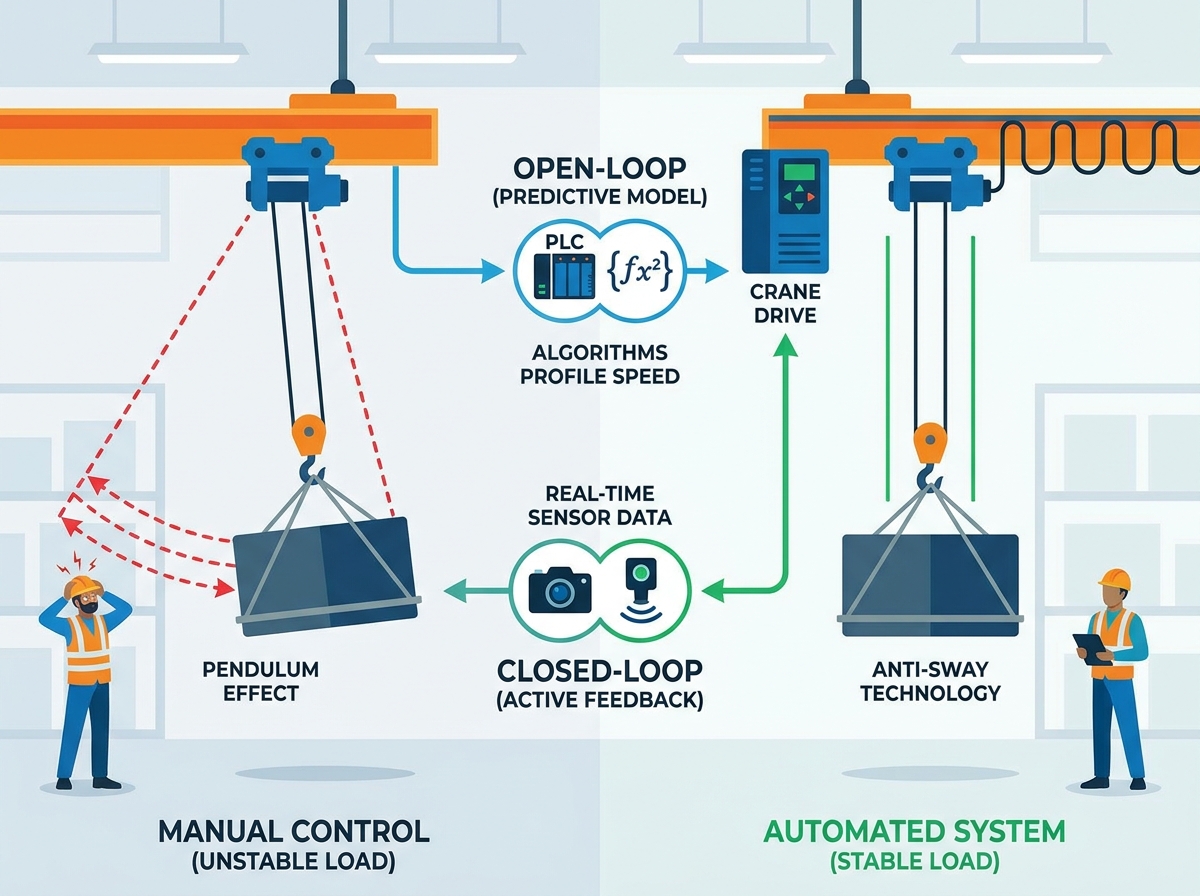
We need to connect technical features directly to tangible operational outcomes. Integrating an Anti-sway Control System transforms how your facility handles heavy materials. You can expect significant improvements across several critical performance categories.
Throughput Velocity: The system translates dynamic speed adjustments into real cycle time improvements. Operators move loads from point A to point B without pausing. You must set a realistic expectation here. Typical operational gains are steady and incremental. This technology is not instantaneous magic. However, shaving ten seconds off every lift cycle yields massive daily throughput gains.
Precision Positioning: Automated micro-adjustments enable incredibly safe handling in tight tolerances. Handling molten metal requires absolute stability to prevent catastrophic splashing. You must slide massive dies into tight press beds without colliding with the machinery. Dense storage environments also benefit heavily from this precise positional control.
Equipment Longevity: You can build an evidence-based expectation of reduced mechanical wear. Automated deceleration curves significantly reduce brake wear over time. Motor thermal stress drops because operators stop "plugging" the controls constantly. These reductions directly translate into extended maintenance intervals. Your maintenance teams spend less time repairing structural fatigue issues.
Operator Democratization: Technology flattens the operational training curve dramatically. The system allows novice operators to achieve the load stability of 10-year veterans instantly. They can move loads quickly without compromising safety protocols. This democratization makes scheduling flexible and reduces the stress associated with seasoned operator turnover.
Selecting the correct technology requires careful analysis of your current operations. You must evaluate several distinct engineering and environmental factors before making a final decision.
First, you must assess strict infrastructure compatibility. Check whether the proposed system integrates natively with your existing hoist and trolley VFDs. Some modern drives feature built-in sway control macros. Older systems often require proprietary, third-party PLC overlays. Adding external PLCs increases both integration complexity and initial hardware costs. Your internal electrical engineering team should lead this compatibility review.
Next, understand the difference regarding greenfield versus retrofit viability. Specifying anti-sway features on a brand new crane build is straightforward. The manufacturer engineers the drives and sensors to work together natively. Upgrading legacy equipment presents a totally different challenge. If your older crane uses basic relay logic instead of modern variable frequency drives, you face a tough road. You generally must upgrade the entire drive system before implementing sway control.
Environmental resilience heavily dictates your hardware choices. You must deeply evaluate sensor durability for closed-loop options. Closed-loop optical systems often fail in heavy-dust environments like steel mills or foundries. The camera lenses become quickly obscured by airborne particulates. Conversely, these same optical sensors excel in clean manufacturing spaces or aerospace assembly bays. Choose your hardware based on your actual ambient air quality.
Finally, differentiate requirements based on tonnage and application specifics. A standard 10-ton indoor bridge crane moving steel coils needs basic open-loop control. The physics are predictable and the environment is controlled. A 30-ton specialized process crane handling hazardous materials demands stricter closed-loop oversight. Outdoor maritime gantry cranes face constant, unpredictable wind loads. These outdoor applications absolutely require active sensor feedback to maintain safe operational control.
Purchasing the hardware only represents the first step. You must actively manage the installation and rollout phases to ensure long-term success. Many facilities fail because they misunderstand the implementation process.
You must dispel the "plug-and-play" myth immediately. Commissioning always requires careful site-specific tuning. Cable length calibration acts as the foundation of the mathematical model. You must measure the hoist parameters precisely. Drive parameter adjustments dictate how smoothly the crane accelerates. Skipping this baseline tuning guarantees poor system performance. You should allocate adequate downtime for engineers to fine-tune these specific operating parameters.
Operator change management presents the biggest hidden hurdle. You must actively address the "operator override" risk. Operators used to manual plugging often fight the system initially. They instinctively want to take over when the load approaches the target zone. They will attempt to manually force the controls. This action actively overrides the calculated deceleration curve. You must mandate structured training sessions. Operators need time to build actual trust in the automated deceleration profile.
Ongoing calibration and maintenance prevent system degradation over time. You must define a strict maintenance schedule for any physical sensors used. Vision systems require regular lens cleaning protocols. You should conduct periodic alignment checks on IMUs and angle sensors. Software requires occasional updates to refine algorithms. If you ignore these maintenance tasks, the system will slowly lose accuracy and frustrate your operators.
An automated Anti-sway Control System represents a strategic investment in operational predictability. It successfully shifts the heavy burden of safety and speed away from the operator. It places that burden squarely onto engineered controls and reliable physics. Facilities achieve faster cycle times, safer working conditions, and reduced mechanical wear. The reliance on variable human skill diminishes significantly.
Your next step requires initiating a comprehensive facility audit. Start by accurately documenting your current lift cycle times. Identify the exact VFD architectures currently running on your cranes. Clearly define any specific environmental constraints like dust or extreme heat. Gathering this critical data prepares you for productive conversations before engaging system vendors.
A: Yes, retrofitting is highly possible but depends on your existing electrical infrastructure. Modern variable frequency drives (VFDs) serve as a strict prerequisite for precise speed profiling. If your older crane operates on traditional contactor or relay logic, you must upgrade the drive systems first.
A: Comprehensive systems actively control both the X (bridge) and Y (trolley) axes to eliminate all directional sway. However, single-axis options do exist for specialized applications where load movement only occurs in one primary direction. Dual-axis control remains the industry standard.
A: Pendulum physics are governed almost entirely by the cable length, not the suspended mass. Therefore, load weight does not fundamentally alter the swing frequency. However, heavier loads do require the VFD to adjust torque parameters to maintain smooth acceleration and deceleration curves.


